21 August 2014

Between Roxbury, CT and a Hard Place

Ah, to be a Googler (or spend enough time there to know about all of its nooks and crannies): Google Correlate powers a lengthy (the summer long?) analysis by David Leonhardt, et al of searches by the rich and the poor. Rich and poor, in this instance, being a bespoke index.

The main takeaway?

BARRY WAS RIGHT
And it's not surprising then they get bitter, they cling to guns or religion or antipathy to people who aren't like them or anti-immigrant sentiment or anti-trade sentiment as a way to explain their frustrations.

The Rednecks love them Guns and God.

Of course, the comments on the article just reinforce that; rather than being the "Land of the free and home of the brave", the USofA is really the "Land (rural) of the stupid and home (urban) of the smart". Doesn't go down all that well with the Tea Baggers (props to Maher, of course). But they're just puppets of Koch, in any case.

Peter, Peter Pumpkin Eater

I've never been a fan of the Austrian schools, just because they're by, for, and of the .1%. There's not much good for an entire economy in that. In looking for data to confirm, or refute, the notion that the Captains of Industry are just playing financial engineering games with all that moolah, I ran across this piece by Peter Schiff. He's a right wingnut, by a wide margin. You can look him up on the Wiki, if you're interested. What caught my eye was this:
In 2009, Gross Private Investment collapsed to almost 12% of GDP, which was the lowest level in the post WW2 period and compares with a median level of 19% in the three decades prior to the Great Recession. Since 2009, Gross Investment has rebounded and is now 16% of GDP. Many growth bulls expect this level to rise over the next few years, noting that the average age of U.S. capital stock (i.e. plant/equipment) is at record highs and needs to be upgraded. Recently, this view has gained traction with improvements in forward-looking surveys, like the Purchasing Managers Index (PMI). In the near-term, we do expect a modest bounce in capital investment to make up from weather related disruptions earlier in the year, but we are more skeptical about a multi-year boom.

First, we believe much of the recovery in private Investment was supported by bonus deprecation tax benefits (initiated during the recession) that enticed many corporations to accelerate investments in 2010-13. These incentives ended on Dec 31, 2013, so businesses have less reason for new investment. For companies to increase investment without government support, sales levels need to increase, which will remain difficult as household balance sheets and incomes remain under pressure. As a note, the current level of private investment (16% of GDP) is below median levels during the thirty years prior to the Great Recession (19% GDP), but it is consistent with the thirty year period following WW2 (17% GDP).

Second, companies have recently been more inclined to acquire rather than try to grow organically. In the first half of 2014, total U.S. M&A deals were over $750B, which was up 50% from the same period in 2013 and on pace to hit annual levels not seen since 2006-2007. Also, almost 95% of recent deals have been strategic (companies, not private equity, buying other companies) which compares with just 75% in 2006-07. If companies saw organic opportunities then this cash would be invested in new plant and equipment instead of paying premiums for existing firms. With easy access to relatively cheap capital, we expect the M&A spree to continue, noting that this will actually result in job losses (vs. capital spending that drives job gains).

Finally, companies that have not found attractive M&A opportunities have been using cash to raise dividends and buy back stock. In the first quarter of 2014, U.S. share buybacks and dividends hit a record level of $241 billion. Returning excess cash to shareholders is normal when growth prospects are dismal, but the recent trend has been exacerbated by activist investors that are pressuring companies to use leverage to return cash. As a result of this, combined with M&A activity discussed above, business (non-financial) leverage is at record levels. This bodes poorly for a surge in real investment.

Closely read, he makes the refuting argument to his basic thesis: the US consumes too much and invests too little. Even though he is credited with calling the The Great Recession, he, by all accounts, missed the motivation; even in the early 00s the Captains of Industry were running from physical investment to financial game playing. Cognitive dissonance rides again.

The hidden truth: the country with the reserve currency of the global economy will always, in fact must, run trade deficits. Think about the situation from the point of view of other economies. They have to get reserve currency in order to acquire goods and services. In order to do that, they have to sell lots o widgets to the reserve currency economy, which means that economy has to buy lots o widgets. As The Great Recession demonstrated, when the global economy gets wonky, even a weakened reserve currency is still the best bet. The alternative is to return to a specie regime, which, among other things, puts the global economy in the hands of the likes of South Africa. The global economy had the chance to switch to a commodity based currency, the petrodollar, in the aftermath of the 1973 OPEC embargo. That never happened for the good and simple reason that the First World economies recognized, even if their leaders would never be so honest as to say so, giving control to natural resource rich, but otherwise backward autocrats didn't serve them. Neither in the long run or short run.

You can't have organic growth when the 1% or .1% control most of the moolah. Especially in light of the fact that you can't eat software.

17 August 2014

An Open Letter to Dr. Shiller [update]

In today's Times Business section, Robert Shiller gives his take on stocks, specifically the question: are they priced too high? He titles the piece (dead trees version), "The Mystery of Lofty Elevations". The web title is similar.

Note, of course the use of the word 'mystery'. Are stock prices really too high? As I've been arguing for some time, NO. Those with piles of moolah to 'invest' have traditionally been in bonds, clipping coupons each quarter. Living off the interest, in simple terms. As even Dr. Shiller has to know, short term interest rates (in particular, the Fed Funds rate) are not what determines long term (corporate) interest rates. The value of corporate bonds is determined by the return earnable from new plant and equipment in the hands of 'job creators'. To the extent that 'job creators' choose to not buy plant and equipment, at any rate of interest, then the long term return to moolah holders will go down.

There's also the matter of the supply of loanable funds, aka "The Giant Pool of Money". It's still around, and corporations continue to hold ever larger amounts of idle cash. They'd love, I'm sure, to be given 10% annually by Washington or Bejing, but that ain't gonna happen. Until such time as the 'job creators' decide that physical investment is more lucrative than fiduciary games, the supply of long term funds will outstrip the demand for such. It's that simple. So far, their notion of smart capital allocation is to stuff it into the mattress.

The Captains of Industry have simply run out of ideas. The digital economy is, on the whole, super-cheap to run. Even as we approach the next (and, perhaps, last) barrier to continuance of Moore's Law (for myself, it looks like physics has repealed the law), the cost per cycle continues to diminish. In any case, the web economy amounts to little more than giants and dwarves fighting over advert buyers and advert clickers. Arabs, and their blue eyed Texas brethren, learned the hard way that you can't eat oil. The web economy will eventually realize that advert peddling is just a lot of wheel spinning; much ado about little.
So I've been trying to come up with a theory to explain today's elevated stock prices -- and maybe convince myself that they could remain lofty for some time. One factor to consider is that bond prices are high, too.

It's as simple as I've said: bond prices are high (yields low) because the Captains of Industry aren't smart enough to figure out new ways to turn moolah into machines. Even with money available at historically low rates, and retained earnings at historical highs, the Captains just don't know what to do with it.
When there aren't enough good investing opportunities, people wishing to save more for the future may succeed only in bidding up existing assets even if they think they're overpriced. Call it the "life preserver on the Titanic" theory.

And, in other words, all those Koch Brothers types who bleat that Americans have to save and invest more ignore the plain fact that corporate America hasn't been able to allocate The Giant Pool of Money that's already sloshing around. Push more money into the Pool, and returns will fall still further. Econ 101.

We can expect yet more bleating from the .1% class that capital gains taxes are ruinous. Why? Since they can't get by on the low coupon returns, they must needs turn to stock price appreciation (as we've seen) and share selling for income. And, of course, since only Little People pay taxes, their incomes shouldn't be taxed. Just watch.

[update]
Seems some of the sell-side analysts (larger fish in the pundit pond than I, alas) take exception. This shouldn't be too surprising, since they make their obscene incomes flogging stocks. But they do have a salient point: they tout forward P/E, while Shiller's CAPE (where's Superman when you need him) is explicitly backward looking and for a long time at that. The notion that more data is better is generally a good thing, except when there's been an inflection in the data of your model, and worse if the inflection is in the recent past. The evidence is clear that the Captains of Industry are using fiduciary capital in more financial engineering exercises and less in buying plant and machines. No physical investment, no hard returns to capital, no interest earned, no demand for additional capital. The causation is that long term earnings determine short term rates. Central banks can hope to manipulate short term rates, and even set one or two, but they can't change the course of science and engineering (the real kind). Without tech progress, there's only foregone consumption to pay the vig. Looking at 21st century economies through the lens of 19th century experience (even to mid 20th) is folly.

It isn't a fluke that The Giant Pool of Money (larger now than then) was dumped into non-productive real estate. The Captains of Industry had no use for it. They still don't.

11 August 2014

A Visit in the Hadleyverse

Hadley Wickham is interviewed by Eduardo Arino de la Rubia in conjunction with the useR! meeting in Los Angeles. He warms the cockles of my heart starting at 15:50 of the interview, when they discuss the bipolar (my term, not theirs) nature of R. Yes, R is both an Excel on steroids (neither of them says Excel, but reading between the lines...) and a kinda, sorta language to write programs. Since most of us know Hadley via his packages (and he's using Rcpp more, lately), and this interview is about how he goes about making same, it's impossible to judge how he feels about R as a stat command language for stats, quants, data scientists, and the like. But it is clear that he gets the difference. It's also my inference that he envisions lots o London Whales making their mistakes in R rather than Excel. Whether that's a good thing is another matter. Sometimes brain surgery should only be done by trained neurosurgeons. If The Great Recession taught us nothing else, it's that quant is too often done cavalierly, by those with little to no understanding of what they're doing, yet with an outcomes' agenda. Bad dog.

07 August 2014

Sovaldi Sings Iago

For those who aren't up on Shakespeare and Rossini, Iago is a bad guy. A really bad guy. Sovaldi, according to some (and a growing count, by most accounts), is the archetype of Big Pharma profiteering; taking money from the many to give to the few for little or no real value.

Sovaldi is Gilead's hep/C vaccine, more accurately anti-viral, which costs $1,000/pill or $84,000/treatment. It is claimed to offer higher cure rate, lower side effects, and shorter treatment period.

Unlike breast cancer or prostate cancer, hep/C, by and large, is a Bad Person's Disease; mostly IV drug users. A lifestyle choice. Mostly, not all. It happens that a large number of the infected are also incarcerated, which shouldn't be too surprising. Turns out prisons don't get mandated discounts. Remember those TV cop shows, where the perp turns out to be an ex-con who just can't seem to get it together on the outside, and heists a bodega in order to get back inside? Likely see more of that.
The drug's virtue, that it frequently cures a chronic and sometimes very costly disease, is not always relevant in the prison setting. Hepatitis C can take up to 30 years to turn from active infection to serious liver disease. Therefore, a costly investment in a cure for those prisoners close to their release date will offer no relief to a prison's long-term medical budget, even if it might improve the prisoner's lifetime health.

In other words, this is what happens when public health problems are shunted off to for-profit outfits. Gilead gets all the profit (they did drop more than $11 billion to buy the company which devised it, though). Taxpayers get all the costs. What would Adam Smith (the real one) say? I mean, where's the cost/benefit analysis of making life more comfortable for drug addicts? There are nearly as effective, far less costly, existing therapies. So, what is the marginal benefit? What is the marginal cost?

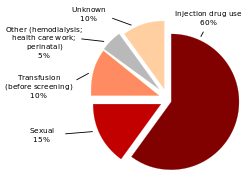
Here's another case where even the 1% will need Obamacare. If the insurance companies, and other right wing scolds ("$84,000 for drug addicts!!") get their way, then far fewer treatments will happen, and Gilead will, unless stopped by the Damn Gummint, raise the price further. By restricting the use of Sovaldi to those who get hep/C, but not through Bad Behavior, the unit price will have to go up in order to preserve Gilead's entitled profit. How much up? Well, according to this chart from CDC data between 5% and 15% of infections can be considered non-willful. Like that word? Very Biblical, that word. So, the innocents infected will have to pay (or some form of insurer) some multiple of $84,000 to keep Gilead in golden threads. Take away 90% of your customers, and, if you can get away with it, the remaining 10% get truly hosed.

Here's the kicker (which hasn't been stated, so far as I've seen): since 60% (more or less) of those infected are IV drug users, and Sovaldi isn't a vaccine which offers immunity to disease, but an anti-viral, we should expect that those 60% will rotate through with some frequency. Drug use: the gift that keeps on giving. Perhaps, at the end of treatment, patients get an 'S' tattoo, indicating that they've had their once-in-a-lifetime Sovaldi treatment. No second helpings.

This is the prototypical case where an army of forensic accountants could be unleashed to discover how much of Sovaldi's claimed development cost actually was spent on the ground, and how much went to SG&A. I'd love to see that number. Not going to happen.

06 August 2014

Big Fish, Little Fish

The NYT DealB%k has an interesting piece from one of the regulars on the Big Fish eating the Little Fish in the cloistered world of the innterTubes. But Solomon leaves out the lede, as they say in the pubbiz: these Big Fish ain't really conglomerates.
The paradox is that conglomerates outside the tech sector are an endangered species. The 1960s was the age of the conglomerates. ITT, for example, made both weapons and movies, with the idea that smart managers could operate any business and different operations would diversify the business. But that strategy did not work out as planned. The problem was that managers needed to focus on their businesses. If investors wanted to diversify, they could do so by simply investing in the separate companies. And splitting off businesses would discipline managers not to waste extra cash.

What he misses, or simply doesn't want to say, is that Google, et al, of today aren't (structurally) anything like GTE, ITT or the rightfully infamous Gulf+Western of Charley Bluhdorn. Those were real conglomerates, with real divisions (ex-companies) in real, different, businesses. With the possible exception (too soon to tell) of Apple/Beats, the rest are all agglomerations of advert pushing platforms. Despite the appearance of differing users and "products" for those users, the real clients are the advert buyers. And they're (Google, et al) all attempting what the New York Yankees have done for generations: buy up any player who's any good to keep said player from ending up with another team. It takes very little to create an web-based advert platform; WhatsApp was, what, 6 guys? If you're Google, that makes your sphincter kinda tight. 93% of its revenue is from adverts, still (last 10-K). How much of its profit is assigned, I couldn't find, but I'll guess all of it. All of the side projects are just that: on the side.

In any case, these aren't conglomerates, just oligopolists aiming to be the monopolist.

25 July 2014

If It's Friday, This Must Be Krugman

Well, not this time. He's needling the right wingnuts about various chimera, as usual. No, but today's Business Section of the Times is full of belly laugh quotes, many of the subjects chronicled here in past missives.

Let's start with Amazon's stool dump. As opined here in the past, Amazon can't feasibly make any money unless it manages to monopolize retail trade. Without a price-fixing monopoly, Amazon is hostage to transport costs. There's a reason they've been madly building 'stores', which they euphemistically re-name 'distribution centers'. Which mostly end up being juxtaposed to railheads. Simple fact: the cost of moving a pound of widget by air freighter is at least ten times the cost of moving a tonne of widgets by freight train. So, more localized stores. Just don't call them 'stores', of course. Unless Amazon can get into position to charge the true cost of delivery, which means monopoly, it'll never make any moolah.
Writers are peeved at Amazon. On Thursday, investors became disgruntled too.
...
"Skepticism is increasing," said Colin Gillis of BGC Partners. "It's hard to have $20 billion in revenue and not make any money. It's a real feat."

Well, no shit Sherlock.

Amazon's new Fire phone has been showered with 'blah' reviews, so I suppose it shouldn't be a surprise that,
[Thomas J. Szkutak, the chief financial officer] declined to say whether Amazon would ever tell investors how many phones it sold. "I can't comment on what we might or might not do here," he said.

Confidence inspiring, that.

"Don't cry for Argentina", I guess. I've not been following the sovereign debt problem really closely, so today's report is awe inspiring. It seems that Argentina and some hedge funds have been arguing over Argentina's right repay on its terms. And this is to be adjudicated in a New York City federal court. Well.
This week's hearing made clear that [judge Thomas Poole Griesa] had not completely understood the bond transactions that he had been ruling on for years.

Oops?

The entire notion that private, American, hedge funds should have the power of US courts to run the governments of other countries has caused some agita. Now, we find the judge is, essentially, clueless. Just run the link. If ever there were a caricature of a doddering old fool... American jurisprudence: of the 1%, by the 1%, for the 1%.
It is not as if no one had pointed out the issues in the many legal briefs and arguments filed in this case, both before Judge Griesa and before appeals courts. But those arguments seem not to have registered. "For this to come out after this has gone through so much legal process, in the most sophisticated financial jurisdiction in America," Ms. Gelpern [law professor at Georgetown University] said, "has to be astounding."

Of course: only little people have to pay attention.
As Wednesday approaches, the judge has a lot to think about. It would be better if he had done some of that thinking before he issued his order, or if the appeals court or the Supreme Court had forced him to do so.

In a similar vein, is Cyprus. In a nutshell, Cyprus banks got into trouble along with the rest of Europe. What made it different was that the banks stored up Russian oligarch money, so when it all went to hell, the little people were made to pay. In order to determine how much the little people would pay, both Pimco and BlackRock were hired, by different folks at different times, to figure it out. The Pimco number was higher, and the BlackRock report was hidden.
As for the BlackRock analysis, it was kept strictly under wraps. So much so, that in internal communications BlackRock bankers used code: Claire for the Cyprus central bank, Peter for Pimco and Ben for BlackRock.

What's a few billion Euros from the little people, when the banksters might run out of cavier?
"We did not know anything about any BlackRock report," said Michael Sarris, the Cyprus finance minister who led the talks with Europe. "If there was anything that identified flaws in the Pimco report or indicated that we needed less money -- then clearly this should have been brought to the table."